Calces : the fate of a civilization
A tribe of fishermen, caught in a storm, washes up on the shores of the island of Oneiro. An island where all species of plants, insects and animals flourish. Where the rivers flow from the highest mountains to the most stretched lakes. Where the forests welcome the whole concert of life. Where we hear the thrush like the wolf, sharing one and the same consideration: time.
But by setting foot on the sand that spreads out in the north of the island, this tribe will forever upset this harmony. The balance will be broken.
Here then is the story of the fishermen of Calce. Of their dreams, of their glories, but also of the deep scars they will leave on Oneiro.

1. Map of Oneiro Island

The history of the inhabitants of Calce and then of Calces spans five ages.
This frieze recounts the key events of its technological and territorial construction, but also the main tools, robots, machines that illustrate these developments.
"The inhabitants worship the fauna and flora of Oneiro. This is the beginning of a passionate bound. "
The Oneiro ecosystem
The Calcestians worship their environment and what composes it. The marine fauna, particularly rich around the island, is a reference for the life of the village. They see in the multicolored reflections and the infinite forms, a harmony with the elements, which brings peace and balance.
This admiration is transcribed in the rites, the architecture of their huts, and will impregnate their destiny. Thanks to this understanding of the environment in which they settle, the Calcestians will integrate into this harmony.
Here are some examples of these fish.

2. Oneiro Ocean Fish Engravings
Plants and trees are also part of village life. Used taking into account their perenity, without disturbing the development of the Calce ecosystem. Even if each sample necessarily alters the balance in the short, medium and long term, a great knowledge of plants, their role and their lifestyles, allows the Calcestians not to break the autonomy of the living._cc781905 -5cde-3194-bb3b-136bad5cf58d_
The same applies to trees, the selection of which is made according to a knowledge of their situation in relation to others, always favoring those which encroached on the growth of a greater number._cc781905-5cde-3194- bb3b-136bad5cf58d_
Calcestians use plants for medicine, protection against animals, dyes and for food.
The trees are used for canoes, huts and tools.

3. Oneiro Flora Engravings
Age 1: The Creation of Calce
year 0 - 440
The tribe of fishermen, driven by the Ave storm, washes up on a white sand beach. They will call it Calce, like sand, like construction. A love story begins between this erudite tribe, technologically prodigious and its environment.


4. Calce beach map

5. Village of Calce

6. Interior Balbe Hut

7. Elevations Hut Balbe
The huts of the Calciens, called Balbes have the wish of perenniality. They consist of a solid structure, curved beams and assembled wooden shells. The wood chosen is that of the alepins, very solid and very resistant. A cabastre cane gives resistance to heat and insects.
They can accommodate a family only to sleep, life being done outside. The Calcestians pay homage to the different fish present in the Oneiro Sea, which seem to come out of the sand, peaceful.
The Balbes have colors that identify which family they belong to.
Turtle shells, placed during ceremonies in place of shields (see elevation and front view), are recovered when they are dead.
They symbolize wisdom and determination.


8. Interior Balbe Hut
9. Whistler and Lynel canoes

10. Pirogues Whistler Elevation

12. Whistler and Lynel canoes

11. Canoe Whistler perspective
Canoes occupy a central place in the life of Calce. Made of Arapoléas wood, they can last for several decades, tossed around by the impetuous waves of the Oneiro Sea. They are piloted by experienced hunters and are used for hunting.
We track schools of fish, crepitins, undertows, or hills of gold. Thanks to its elongated shape, it never sags in the water, and, carried by its sail and the strong winds off the coast of Oneiro, the canoe moves at phenomenal speed. The sail itself, made of arastres fibers, offers a tonicity which makes the wind resistance important. It takes real physical strength to hold the sail and the canoe, which you steer according to the wind and the weight of your body.

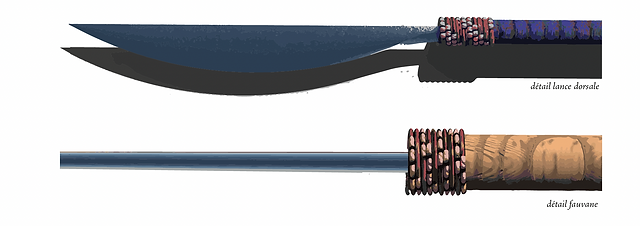
To hunt, the Calcians mainly use spears called "dorsal spears". They are made of arapoléas or aleppin wood and are of formidable solidity. They are used to hunt marine life and designed to cut through the water with the greatest possible velocity.
Like the harpoon or "fauvane", these weapons are also used during initiations for accession to the rank of hunter. We then obtain the right to cut a branch of arapoléa or alepin (depending on its position in the ecosystem).
The fabric tied at the top or at the grips serves to insulate the wood from possible contact with blood. Their density means that they only stay wet for a very short time. Weapons can thus be kept longer.
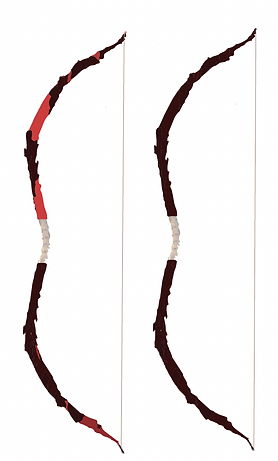
Bows are used for self-defense. When an animal prowls around the village (usually big cats, birds of prey, or even wild cats) it sometimes becomes necessary to kill it with the bow, to protect the infants. In this case, the animal is eaten afterwards, and its skin used for clothing
13. Engravings Hunting spears
15. Details defense bow
14. Fauvan detail and dorsal spear
The knives, also called “moonheads” illustrate the relationship of the Calcians with the marine fauna of Oneiro. Their shape is designed for cutting and drilling. The teeth are also cut to pierce the animal's heart immediately, so that it suffers as little as possible. Hence, the entrails can be removed there also with the help of the extremities. The metal is mastered very quickly by the Calcians, and it takes many years to wear it down. Aleppo wood ornaments are also used to pay homage to fish, and to make tools identifiable. These knives have immense symbolic value


In the Calcestienne tradition, the fish is cooked over a wood fire, having previously been cut over its entire surface. Tubules and fatty hearts are then added and the fish is then shared by the current chief of the village.
It takes:
- 1 bunch of fat hearts
- 3 fresh tubules
- Wild garlic
- Sel
- Pepper
16. Moon point knives

17. Engravings Masks of Elendil
Rites are deeply rooted in Calce's life. They translate the whole hierarchy which is organized around several roles: directing, hunting, gathering. They are intimately linked, because they call on a great knowledge of the living, and therefore on an orientation of the life of the village according to its vagaries. But also to a desire to gather, to unite, in the celebration of life, and of the eternal link with nature. For this, a chief is chosen each year, according to the unanimous will of the village. He or she does not, however, enjoy any particular material advantage, other than wearing the Omün amulet. It symbolizes unity, gathering, and the peaceful strength of the elements.
The masks are worn during ceremonies (accession to the rank of hunter, election of the chief), and can be dyed, again with plants. They are called masks of Elendil. Both the amulets and the masks are mounted in a wooden structure. We then encrust a precious stone for the amulet, and we make straw caning on the masks.


18. Masks of Elendil front view
1 9. Amulet of Omün
Age 2: Build Calce
year 440- 1228
While their dearest wish is to maintain a balance with their environment, their technical power will gradually move them away from this goal. They will choose to master this nature, to no longer depend on these whims, to no longer subsist, but to live. Now settled on the Calces clearing, a few steps from Oneiro beach, they will found a village that will mark the beginning of a new era. Their love for nature is still alive, but through breeding and agriculture, they mark a breaking point.


20. Calce village map on the plain

21 Calce village perspective

The Balbes still inspire the Calciens, but they are getting bigger. Most are raised, depending on the number of inhabitants of the dwelling. A straw canage prevents the invasion of animals or insects. We take the structure in crossed beams, and we add a balcony. The straw is dyed, taking up the traditions of Calce. Village life is punctuated by a collective agreement, but the rites have disappeared. We enjoy the pleasures of nature, and the comfort brought by the growing technological progress. Animals are now removed from the spiritual life. We respect them, but we no longer deify them. The agreement, in the preservation of the respective territories, becomes conflictual.
The dwellings take the name of "Tabantha", and consist of an arapolea structure. We then add solid grass like lubulaster. The houses are insulated with large fiber weaves. We mostly leave the top visible and open, even in rainy weather, the shape of the Tabantha allowing perfect water drainage anyway.
22. Layout of houses in the village of Calce

23. Tabantha side view

24. Tabantha front view

25. Interior Tabantha

To keep uncertainties away, and to ensure a constant supply of food, the Calcians began to cultivate the soil. They then invent machines to plow it, the kargones, which seem to be inspired by moles. They also equip themselves with tools, with a new mastery of metal, making it very sharp and solid, greatly facilitating the drilling effort. The kargones are a wooden structure drawn by the first animals exploited by the Calcians: the yakoulaskis. There is then a march forward which engages, because the more the Calcians draw, the more their comfort increases. This will subsequently lead to surprises, even major upheavals.
26. Kargones View

27. View facing Kargones

28. Kargones View

28. Groove detail
Age 3: Calces
year 1228 - 1921
Embarked on an increasingly rapid expansion, the Calcians will see their destiny changed forever when they discover an extremely rare metal, with almost infinite faculties. This metal produces an electric current, is of prodigious resistance, and above all can merge with other metals to strengthen itself. The Calciens then enter an era of increased exploitation of resources, with the dual idea of continuing to increase their influence, their quality of life, but also of finding other materials.
Thanks to the discovery of a certain Iron Shifting, on the mechanization and the combustion of wood in energy of motricity, the Calciens will build the first machines, which multiply by a thousand the output and thus the deforestation and the exploitation of the clearing.
But this prosperity will make people envious, and the Calcians will have to defend themselves against new enemies: the Ragnassians, coming from the mountains of the East and Mount Extasius.
They will invent weapons, and barricade themselves behind thick metal walls. A city was born, taking on the now deified form of gears. Calces replaces Calce, and the Calcestians swing into the unknown


29. City map of Calces

30. Calces building elevation
The Calcestians are housed in buildings that take the shape of the surf fish, once deified by their ancestors. The black soot of the machines covers the red brick of the lands of the plain of Calces. Inside, the Calcestians are housed summarily, in a space where there are few openings to avoid the intrusion of clouds of dust. The Calcestians become slaves to the machines. It takes a large and skilled workforce to make them work. Locked up in metal giants or black brick colossi, the Calcestians lose their link with the living. The air becomes dry and nauseating and the sky is gagged. Soon the human vices emerge and the inhabitants separate, clouded in uncertainty.

31. Perspective rue de Calces

32. Perspective rue de Calces

33. Perspective rue de Calces

34. TX-Rimmar Perspective

Calces machines, otherwise known as Fracasses or Tx.Rimmar. 182, are colossi over 20 meters high. There are several types, but the most formidable being this one: Dévore-Cime.
This machine assembled by Iron Shifting, the creator of the technology, is used for deforestation and drilling. Their blade, Celeste, can slice through twenty trees with no problem at once. The drill digs up metals. Subsequently, the metal giant gives way to other machines that harvest resources and transform them. It is said that there are about fifteen workers working in the heart of the machine, locked in the sweltering heat and the frantic rhythm of activity of the colossus. Only one pilot is necessary, he takes place in the cockpit whose glass is reinforced. The assembly of the machine, just like its construction, is carried out at La Vitesse, the nerve center of the city.
35. Tx-Rimmar cockpit view

Forged in the vats of La Vitesse, the activity center of Calces, Celeste is an unbreakable metal blade. It hinges on the machine, but often requires maintenance because mud can damage the connection to the machine control. It is over 8 meters long, which is an unprecedented technological feat. Imagine that the Calcestians were once peaceful fishermen! The scavengers, above, are mechanical snakes that burrow underground to find rare metals, and break the roots of trees to facilitate the work of machines.
36. Bottom view Tx-Rimmar

37. View Celeste swords

38. Elevation P-12 Rim

Invaded by the Ragnassians on multiple occasions, the Calcestians must create sufficiently robust weapons to guarantee the security of Calces. They then invent formidable weapons, the Fujiaki, in reference to the love of one of the creators, a certain William Guest, for an astonishing land lost in the seas of Oneiro.
These weapons are packed with explosives in their bulbs, and then torpedoes are inserted. Then, using a flame, the center of the Fujiaki is ignited, and when the head lever is activated, the explosion generated propels the torpedo and the explosives towards the enemy. It is among other things these weapons that will guarantee the independence of the Calcestians during the great war of Chymos, but this at the cost of many human sacrifices, which will deeply mark the population.
P - Rim - 12 fighters, in addition to weapons, guarantee independence and security in the seas of Oneiro. The beach, now gradually used as an underwater base, and as a fishing port of course, is constantly watched by Hunters. They are armed with torpedoes that can even split cliffs, which can also be useful when expanding Calces on the sea.
38. View P-12 Rim

39. View P-12 Rim

40. Elevation torpedoes

41. Fujiaki rifles elevation
Age 4: Expansion
year 1928 - 2730
The frenetic growth continues, as does the exploitation of resources. Calces has extended its hold to the whole of the island of Oneiro, except the east, which is still occupied by the Ragnassians. Their technological power is limitless, and a new wave of manufacturers will increase the dominance of the population with machines that control and guide their life choices. However, the artistic liberation of men makes life more acceptable, as does the overall increase in standard of living, longevity and comfort. But little by little, the natural spaces are disintegrating, and the Calcestiens feel in their entrails this blow to their ancient beliefs. Voices are raised to think of the city differently.


The times are for technological and military expansion. Calces is developing two types of tools that will considerably increase its hold on external populations and their resources. Killer Bees, an ironic name if there ever was one, are flying robots that can kill any target with millimeter precision and that at several hundred meters. They move in swarms and overpower the enemy quickly. When the eyes turn red, it is better to pray.
The Oblunes are small robots, also flying, which suck up the resources present in the clouds (hence their additional name of cloud-breath). By pumping their energy, they considerably limit meteorological stability, but also rain. This is why it is necessary to limit its use and especially, to do it at the neighbors.
42. Cloud View Killer Bees

43. Killer Bee Elevation

44. Killer bee view

45. Killer bee view

46 Oblune top view

47 Oblune side view
48 Oblune front view

49. Kenaï robot perspective view

Kenai robots are close to invincibility. Built to promote the expansion of Calces in other regions, they know no defeat. Their skin is made of an extremely rare metal that does not oxidize, cannot be pierced once frozen, cannot be scratched, and can have any desired appearance. These are also the metals used for the readers presented above. In addition to being formidable fighters, they can autonomously search for their own metals or energy. It is moreover this option which will lead to the collapse of Calces, at least for the moment.
50. Kenaï robot perspective view
Readers are flying robots that project advertisements, or more rarely information. They move around the city and when a gathering takes place, or a person seems to stare aimlessly around the city, they project in their direction, sometimes even directly at the human being. This aggressive policy will greatly favor the expansion of consumption in Calces.

52. Reading lights perspective view
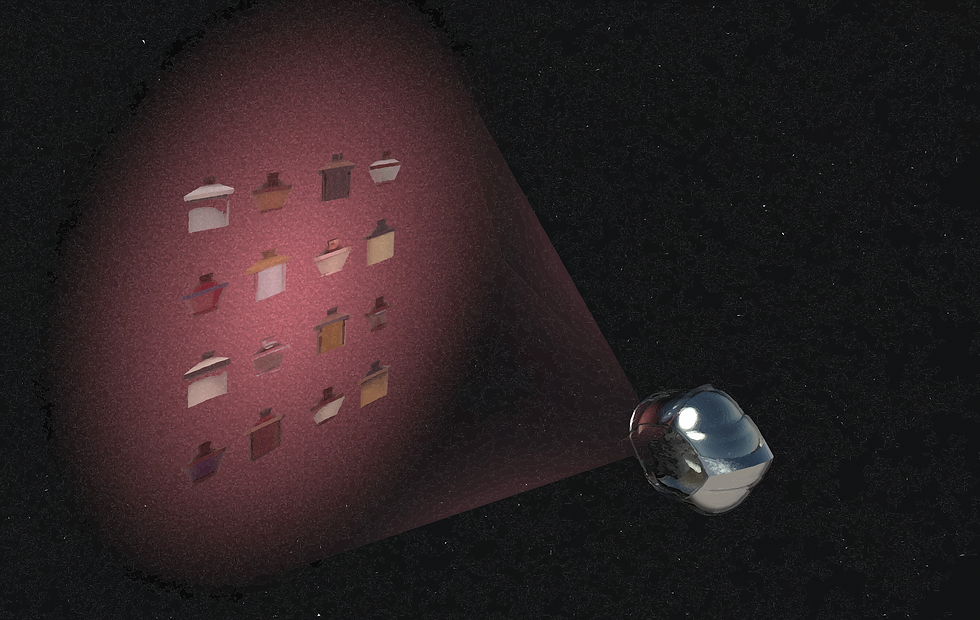
52. Reader. perspective view
The Edoras vases mark the turning point in the creations of the manufacturers of Calces who let their creativity explode in a rise in consideration and recognition of the craft of manufacturer. This is also related to the explosion of consumption and the vision of the tool as decoration and aesthetic expression. This collection, imagined by a young manufacturer, evokes the memories of the ancestors and especially the story of Edoras, a skilled rider who reigned over the high plateau of Syla, and whose civilization was master of the elements and materials.

53. Elevation view Edoras vases

54. Elevation view Edoras vases

55 .Edoras vase elevation view

56- Edoras vase elevation view

57. Edoras vase elevation view
Age 5: The will of a symbiosis
And with a pickaxe, among the millions launched so far, everything changes. A Kenai robot hits a gas field, thinking it hits a metal pit. The touch releases the vaporous into the atmosphere in a deafening explosion. This gas is toxic and infects the lungs and cells of humans who come into contact with it. It is invisible, and its effects are also very contagious.
He sows chaos in the city, and half of the population flees towards the South of Oneiro.
But some decide to stay and imagine a new city. They are aware that it is no longer possible to drain so many resources. The Calcestian model of subsistence, based on the production and exploitation of resources, is obsolete. The ecosystem and the link that civilization had with it must be restored.
This is now the wish of the manufacturers: to create a city, a lifestyle that allows a life in harmony with the living from which it comes. A peaceful relationship that would make it possible to survive, and to flourish otherwise.


58. Azufel deer elevation Hart
While the response to disturbances becomes cohabitation with the ecosystem, the manufacturers imagine the deer of Azufel. These robots are bridges between humans and living things.
They are independent, have their own exponential intelligence, and are equipped with billions of sensors. They allow them to capture information on living things, their activity, their evolution, so that people can know the ecosystem optimally and make wise decisions when they intervene. Deer can also interact with animals, giving them information about humans. A bridge is created, putting all the living on an equal footing, thanks to a machine.

59. Elevation view of Azufel stag

60. Azufel stag elevation

61. Elevation view of Azufel Hart

62. Bouldo perspective view
The Bouldo is a smart floor lamp. It is located in the town of Calces and in the ecosystem that adjoins it. When a man gets closer, it gradually lights up to full light when he is next to it, then it gradually goes out when he moves away. It's a way to reduce light pollution, and leave the living in peace at night.

63. Bouldo perspective view
The Mandibes, or Baarak, depending on the type of material that covers it, mark a real revolution in Calces. Because these houses work. The idea of the manufacturers of Calces was to have a dwelling that was self-sufficient. Which can produce its own energy, manage its waste, repair itself and which greatly reduces the footprint of men. Then the idea of a house that moves, thereby producing kinetic energy, appeared. Mobility also reduces the footprint on the ground, the development of roads, the perpetual enlargement of the spaces inhabited by the Calcestians. They forced manufacturers to reinvent all Calcestian lifestyle habits.

64. Front view position 3 Mantibe

65. Front view position 3 Mantibe

66. Front view position 3 Mantibe
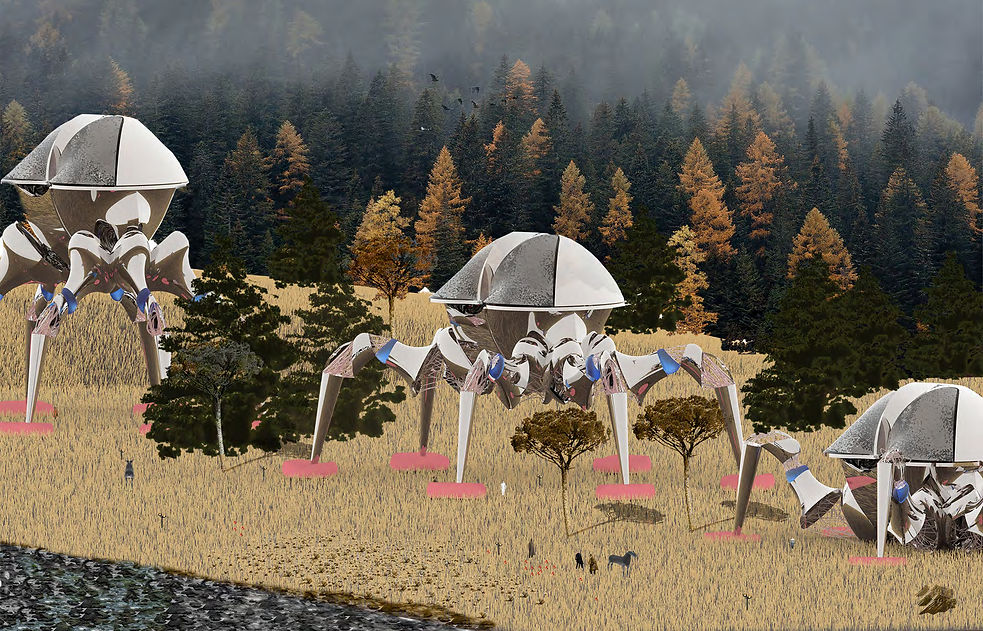
67. Perspective view Calces II
"Calces has become a technological superpower in symbiosis with its environment. This story is told in CALCES: LIVING WITH ONEIRO"